
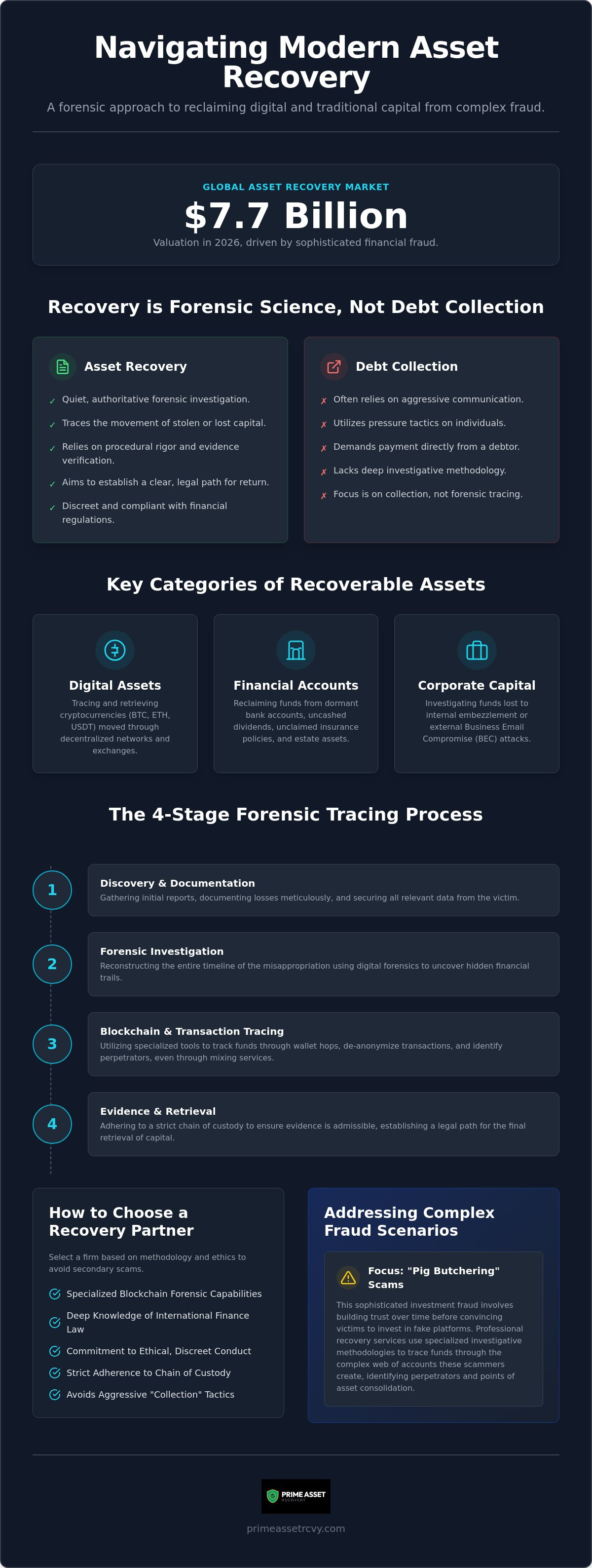
The global asset recovery services market has reached a valuation of $7.7 billion in 2026, reflecting a sharp rise in sophisticated financial fraud that requires more than just traditional collection methods. When you realize your capital has been diverted through complex blockchain networks or cross-border schemes, the initial instinct is often a paralyzing fear. You might worry that seeking help will only lead to further exploitation by recovery scammers or that the technical wall of digital ledgers is impossible to scale.
It's understandable to feel overwhelmed by the lack of clear legal standing in international fraud cases. However, successful asset recovery is a methodical forensic science rather than a series of aggressive tactics. This guide provides the expert-led roadmap you need to navigate these difficult landscapes, focusing on forensic investigation and the identification of perpetrators. We'll examine how professional verification and blockchain intelligence can dismantle the complexity of your situation to help restore your financial stability.
Key Takeaways
- Distinguish between the reclamation of traditional financial accounts and the forensic requirements of digital fund retrieval.
- Understand how blockchain forensics provides the necessary evidence to trace capital through decentralized networks.
- Learn the essential criteria for selecting a professional asset recovery partner to avoid the risks of secondary fraudulent schemes.
- Identify the specific investigative methodologies utilized to address complex investment fraud, such as "pig butchering" scams.
- Establish a methodical sequence of actions to document losses and secure professional assistance for fund retrieval.
What is Asset Recovery? Defining the Modern Landscape
What is Asset Recovery? essentially entails the professional process of locating, identifying, and reclaiming misappropriated funds or property. It isn't merely an administrative task; it is a sophisticated forensic discipline. While traditional recovery might involve locating dormant bank accounts or unclaimed estate assets, the modern landscape has shifted toward digital assets and complex financial fraud. This evolution requires a blend of legal knowledge and technical proficiency that standard law enforcement agencies often lack due to jurisdictional boundaries and resource constraints.
The Distinction Between Recovery and Debt Collection
It's vital to separate recovery from the practices of debt collection. While collection agencies often rely on aggressive communication and pressure tactics, recovery is a quiet, authoritative forensic investigation. The focus remains on procedural rigor and verification. We don't demand payment from a debtor; instead, we trace the movement of stolen or lost capital through complex global financial systems to establish a clear legal path for its return. This methodology relies on deep industry knowledge and a commitment to ethical conduct, ensuring that every step taken is legally sound and verifiable. This approach ensures that the recovery process remains discreet and compliant with international financial regulations.
Key Categories of Recoverable Assets
Modern recovery efforts generally fall into three primary categories, each requiring a different investigative methodology:
- Digital assets: This includes tracing and retrieving cryptocurrencies like Bitcoin (BTC) and Ethereum (ETH), as well as stablecoins like USDT that have been moved through decentralized exchanges.
- Financial accounts: Reclaiming funds from dormant bank accounts, uncashed dividends, or unclaimed insurance policies and estate assets.
- Misappropriated corporate capital: Investigating funds lost through internal embezzlement or external business email compromise (BEC) attacks.
Success in these areas depends on the ability to navigate the technical complexity of blockchain transactions while maintaining a high level of confidentiality and professional integrity. By organizing information into clear, thematic blocks, a professional firm maintains a steady tempo that mirrors a professional consultation, focused on delivering actionable results.
The Forensic Tracing Process: How Assets Are Located
The path to successful asset recovery begins with a rigorous forensic investigation for fraud. It isn't a matter of luck but a disciplined methodology that moves from the initial report to the final retrieval of capital. Investigators don't simply look for missing money; they reconstruct the entire timeline of the misappropriation. This reconstruction relies on digital forensics to uncover hidden financial trails that perpetrators believe they've erased. Every piece of data collected must adhere to a strict chain of custody to ensure its admissibility in legal or administrative proceedings. This methodical progression ensures that the investigation remains objective and verifiable at every stage.
Blockchain Forensics and Transaction Tracing
Tracing stolen cryptocurrency requires a deep understanding of ledger mechanics. Forensic experts track transactions from a victim's wallet through various intermediate hops until the funds reach a known exchange or service provider. Specialized tools like blockchain forensic audits are essential to identify the owners of specific wallet addresses. These tools allow investigators to de-anonymize transactions by linking wallet clusters to real-world entities. Even when perpetrators use mixing services to obfuscate the trail, advanced heuristic analysis can often bypass these hurdles. Choosing a Financial Asset Recovery Firm with these specific technical capabilities is the only way to manage such complex digital landscapes effectively. Specialists use volume analysis and time-stamping to pierce through layers of obfuscation.
Financial Documentation and Evidence Gathering
Evidence is the foundation of any recovery strategy. To build a case for the recovery of misappropriated funds, investigators require specific records such as wire confirmations, communication logs, and detailed account statements. Communication logs are particularly valuable; they often reveal the psychological tactics used by fraudsters to manipulate their victims. When combined with account statements, these logs create a comprehensive narrative of the fraud. Forensic accounting is the application of investigative and analytical skills to resolve financial issues in a manner that meets the standards required by a court of law. This narrative is essential for convincing exchanges or legal authorities to freeze assets while a formal claim is processed.
Effective asset recovery requires a partner who understands both the technical and the procedural requirements of high-stakes investigations. If you've lost access to capital, engaging a blockchain investigation service early can prevent the trail from going cold. This structured approach ensures that the recovery process remains focused and legally defensible, providing a clear path toward financial restoration.
How to Choose a Financial Asset Recovery Firm
Selecting an asset recovery partner requires a discerning eye and a commitment to due diligence. It's a high-stakes decision where the wrong choice can lead to secondary victimization. Many fraudulent entities, often termed "recovery scammers," operate by promising immediate results in exchange for upfront fees without performing any actual investigation. A legitimate firm relies on a calm, matter-of-fact delivery of its capabilities rather than aggressive sales tactics or unrealistic guarantees. It's essential to verify that a firm has 15+ years of industry experience, as longevity in this sector suggests a history of ethical conduct and successful resolutions.
Competence in this field is defined by the integration of two distinct skill sets: forensic technical tracing and comprehensive Legal Support Services. Technical data alone rarely results in the return of capital; it must be paired with the procedural rigor required to interact with financial institutions and regulatory bodies. A firm that acts as a discreet partner will guide you through the complexities of cross-border fraud, ensuring that the evidence gathered is sufficient to trigger administrative or legal action. This balanced approach protects your interests while maintaining the confidentiality necessary for sensitive financial matters.
Essential Credentials and Experience
Professional firms must demonstrate deep expertise in both traditional financial structures and the nuances of blockchain technology. You should prioritize investment scam recovery experts who can provide documented proof of their investigative methodology. Verify their track record in handling high-stakes cases and ask about their established relationships with global cryptocurrency exchanges and law enforcement agencies. These connections are often the difference between a stalled investigation and a successful freeze of stolen assets. A firm's ability to navigate these institutional relationships is a primary indicator of their professional standing.
Questions to Ask During Your Consultation
A professional consultation should feel like a methodical assessment of your situation. Ask the firm about their success rate with specific modern schemes, such as "pig butchering" or romance-based fraud. Inquire whether they provide a detailed blockchain investigation service report that can be used as evidence for police reports or exchange claims. Finally, ensure you understand their fund disbursement process. A reputable firm will have a clear, transparent protocol for how recovered capital is returned to the client, ensuring financial stability is restored without unnecessary delays or hidden costs. For investors who have successfully reclaimed their capital and are ready to focus on growth, you can learn more about JGL Capital LLC to explore asset-backed real estate and commercial loan options.
Strategic Recovery for Specialized Scenarios
The global asset recovery market, valued at approximately $7.7 billion in 2026, reflects a landscape where retail investment fraud has become increasingly sophisticated. While international focus often rests on state-level corruption, the primary volume of modern cases involves targeted scams that exploit psychological triggers and technical gaps. These specialized scenarios require a tailored investigative strategy that accounts for the unique legal hurdles of each fraud type. Success in these high-stakes investigations depends on a firm's ability to adapt its methodology to the specific platform or asset class involved. We see a growing trend toward unified platforms to manage these recoveries, reducing the operational risk for victims seeking to reclaim their wealth.
Cryptocurrency and Investment Scam Recovery
Victims of modern trading platforms often encounter "pig butchering" or romance-based schemes. These perpetrators utilize fake forex broker apps to simulate market gains, encouraging further investment before disappearing with the capital. A successful fake forex broker recovery requires a forensic audit of the application's transaction history to separate simulated data from real-world transfers. To recover stolen bitcoin or other digital assets, forensic experts trace the flow of funds to centralized exchanges where KYC (Know Your Customer) and AML (Anti-Money Laundering) protocols are in place. This allows for the potential identification of the account holders involved in the fraud. The methodology for pig butchering scam recovery centers on documenting the transition from private wallets to these regulated institutions. Precision is the primary requirement here.
Dormant Accounts and Unclaimed Estates
Traditional assets also require specialized handling, particularly when dealing with dormant bank account recovery for estates and heirs. Wealth often remains unrecovered because of administrative dormancy or the complexities of probate law. A professional dormant account search service can locate forgotten insurance policies, uncashed dividends, or bank accounts that have been escheated to the state. Given the varying reporting deadlines across different jurisdictions, timing is critical for heirs trying to recover funds from closed estate accounts. Navigating the legal disbursement process ensures that these assets are returned to their rightful owners with procedural rigor. Globally, there is a trend toward greater centralization of seized asset recovery data by regulatory bodies, enhancing efficiency in these complex cases.
If you have fallen victim to a fraudulent trading platform, contact our team for specialized investment scam recovery assistance today.
The Path Forward: Engaging Professional Recovery Services
Discovering a significant financial loss is a moment of profound vulnerability. It's natural to feel a sense of urgency, but resolution requires a shift from emotional distress to methodical action. The initial steps you take after identifying a misappropriation will define the trajectory of your asset recovery efforts. Acting with precision rather than panic ensures that critical evidence remains intact and that you don't inadvertently alert perpetrators. Engaging a specialist early allows for the immediate preservation of digital footprints that might otherwise be purged by automated systems or deleted by fraudulent actors.
Professional recovery restores more than just diverted capital; it restores financial peace of mind. By transferring the burden of investigation to a seasoned specialist, you gain a discreet partner who understands the gravity of your situation. This partnership is built on a foundation of security and confidentiality, ensuring that your sensitive financial data is handled with the same rigor as a legal institution. The goal is to move from a state of uncertainty to a position of stability through a structured, evidence-based approach.
Initial Assessment and Case Viability
Every engagement begins with a comprehensive forensic investigation for fraud intake. This stage is vital for establishing the technical and legal feasibility of your case. A professional firm doesn't simply accept every report; instead, it performs a preliminary audit to determine the likelihood of a successful retrieval. This assessment involves verifying the movement of funds and identifying the jurisdictions involved. We prioritize transparency during this phase, providing an honest evaluation of the challenges ahead. Protecting your interests means ensuring that resources are only deployed when there is a clear, forensic path toward resolution. Your information remains encrypted and accessible only to the investigative team throughout this process.
Taking the First Step Toward Resolution
Time remains a critical variable in the retrieval of misappropriated wealth. Transaction logs on centralized exchanges and communication records are often subject to retention policies that can result in data loss if not secured quickly. A methodical, expert-led approach eliminates the guesswork and helps you avoid the pitfalls of secondary "recovery scams" that target individuals in distress. By documenting every interaction and tracing every digital hop, you build a defensible case that financial institutions and law enforcement can act upon. The resolution of complex fraud is rarely instantaneous, but a disciplined strategy provides the most reliable route to reclaiming what is yours.
Resolution begins with a single, informed decision to seek professional assistance. Restoring your financial standing is a process that requires both technical sophistication and procedural integrity. To begin your journey toward financial restoration, Contact Prime Asset Recovery for a professional consultation today.
Restoring Your Financial Stability
Reclaiming misappropriated wealth is a complex process that demands a fusion of forensic intelligence and legal precision. As we have explored, modern tracing techniques can pierce through layers of digital obfuscation. Selecting a legitimate firm remains the most critical decision a victim will make. Success in these high-stakes investigations relies on a methodical approach that prioritizes evidence over aggression. This structured path is the most reliable way to navigate the evolving landscape of global fraud.
With 15+ years of forensic experience, our team operates as a discreet partner in your retrieval efforts. Our specialized blockchain investigation service provides the technical depth required to track capital across decentralized networks. We maintain a steadfast commitment to client confidentiality at every stage of the asset recovery process. You don't have to face this technical complexity alone. Secure your financial future with a professional asset recovery search and take the first step toward resolution. There is a clear path forward, and the right expertise can help you find it.
Frequently Asked Questions
What is the definition of asset recovery in a financial context?
Asset recovery is the professional process of identifying, tracing, and reclaiming misappropriated funds or property. This involves a combination of forensic investigation, legal procedures, and administrative actions to return capital to its rightful owner. While the term is often used in state-level corruption cases, it's equally applicable to private individuals seeking to reclaim wealth lost to fraud or administrative dormancy. It's a methodical discipline that relies on evidence rather than aggressive collection tactics.
Can stolen cryptocurrency actually be recovered?
Stolen cryptocurrency is recoverable through specialized blockchain forensics and institutional intervention. Since blockchain ledgers are public and immutable, every transaction leaves a permanent trail that experts can trace to centralized exchanges. Once the funds reach an exchange, investigative reports can be used to request a freeze on the assets. This process relies on technical precision and cooperation with regulatory bodies. It's a complex task that requires deep industry knowledge of digital ledger mechanics.
How long does the asset recovery process typically take?
The timeline for asset recovery varies significantly based on the complexity of the case and the jurisdictions involved. While a preliminary forensic audit may take only a few days, the full retrieval process often spans several months. Factors such as the responsiveness of financial institutions and the speed of legal filings influence this duration. A methodical approach ensures that each step is executed with procedural rigor, providing the most reliable path to a definitive resolution.
What are the red flags of a recovery scam I should avoid?
Red flags include demands for upfront fees before any investigation has occurred and promises of guaranteed results. Scammers often use aggressive sales tactics or claim to have inside connections at government agencies. A legitimate firm will provide a realistic assessment of your case and rely on matter-of-fact communication. Always verify a firm's industry experience and ensure they have a verifiable physical presence. Professionalism and transparency are the primary indicators of a legitimate service provider.
Is it possible to recover funds from an offshore investment scam?
Recovering funds from offshore entities is possible through international legal support services and cross-border forensic tracing. While these cases present jurisdictional challenges, investigators can often trace the movement of capital into regulated financial systems where freezes can be enacted. Success depends on the ability to navigate complex international regulations and coordinate with local authorities. This process requires a discreet partner with deep knowledge of global financial administration and a commitment to ethical conduct.
What is the difference between asset recovery and a bank chargeback?
Asset recovery is a forensic investigation into lost or stolen wealth, whereas a chargeback is a consumer protection mechanism for disputed card transactions. Chargebacks are typically limited to specific timeframes and transaction types, often failing in cases of complex investment fraud or wire transfers. Professional recovery addresses broader scenarios, including cryptocurrency theft and dormant accounts. It utilizes specialized tracing tools and investigative methodologies that banks don't typically offer to their retail customers.
How does a blockchain investigation service track anonymous transactions?
A blockchain investigation service tracks transactions by analyzing public ledger data to identify clusters of wallet addresses. While individual wallets are pseudonymous, their behavior and interactions with known entities reveal the flow of capital. Experts use heuristic analysis and attribution software to link these digital trails to real-world exchanges or service providers. This methodology allows for the de-anonymization of perpetrators once the funds move through regulated gateways. It's a precise science that requires significant technical expertise.
Do I need a lawyer for the asset recovery process?
You don't always need a private lawyer to initiate the process, as forensic firms often handle the primary investigation and administrative filings. However, legal support services are frequently integrated into the recovery strategy to manage interactions with court systems or law enforcement. A professional firm acts as a reliable guide, coordinating the necessary documentation and evidence. This ensures that any legal actions taken are based on verifiable forensic data, which is essential for a successful outcome.

