
With over $7.9 billion lost to investment scams in 2025 according to FTC data, the realization that your trading platform is unresponsive isn't just a personal setback; it's part of a global crisis of digital asset theft. When you find yourself searching for fake forex broker recovery solutions, the initial panic can be paralyzing. You've likely spent days refreshing a frozen dashboard or waiting for a customer support email that never arrives. It's frustrating to feel that your capital has vanished into an opaque web of blockchain transactions, leaving you with little more than a sense of total financial loss.
We understand the gravity of your situation and the need for a disciplined, methodical response. This guide provides a professional methodology for identifying fraudulent platforms and the forensic steps required to trace and recover misappropriated funds. We'll examine how to verify a broker's regulatory status using tools like the CFTC's RED list and explain the technical process of blockchain investigation used to locate stolen assets. You'll gain a clear roadmap for fund retrieval and learn how professional forensic tracing can identify actionable exit points at regulated exchanges to secure a resolution.
Key Takeaways
- Recognize the deceptive architecture of simulated trading platforms and the psychological tactics used to manipulate withdrawals.
- Secure remaining capital by immediately ceasing communication and preserving digital evidence such as trade logs and TXIDs.
- Understand how blockchain forensics facilitates fake forex broker recovery by tracing misappropriated assets to actionable exchange exit points.
- Coordinate with international regulatory bodies and law enforcement agencies to establish a formal record of financial fraud.
- Implement a rigorous vetting process to distinguish professional recovery services from secondary "recovery of the recovery" scams.
Identifying the Architecture of a Fake Forex Broker Scam
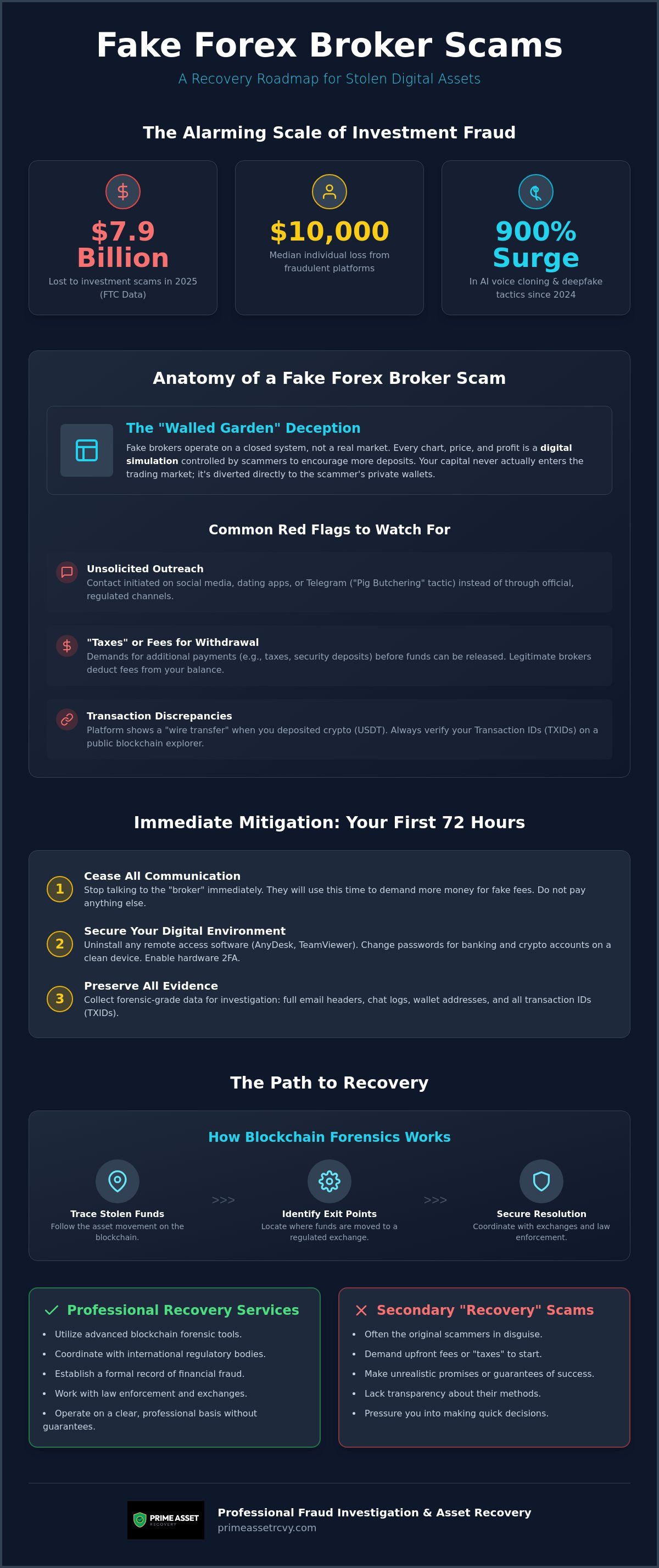
A fake broker is a criminal enterprise masquerading as a financial institution. Unlike a legitimate brokerage where trades reach the interbank market, these platforms operate as a "walled garden." Scammers manually adjust every chart, candlestick, and profit margin to encourage further deposits. This isn't just a high-risk investment; it's a sophisticated form of Foreign exchange fraud designed to ensure your capital never leaves the scammer's control. Every dollar shown on the dashboard is merely a digital simulation of wealth, while the actual assets have already been siphoned into private wallets.
The technical facade often relies on mobile applications that mimic professional software like MetaTrader 4 or 5. These fraudulent apps are frequently distributed via direct links rather than official app stores to bypass security screenings. Once installed, the scammer uses Fraud-as-a-Service (FaaS) toolkits to manipulate the data in real-time. If a victim attempts to withdraw funds, the "account manager" may use AI voice cloning or deepfake videos to provide a sense of legitimacy, a tactic that has surged by 900% since 2024 according to Volity reports. Initiating a fake forex broker recovery requires the realization that the platform balance is a complete fabrication.
Common Red Flags of Fraudulent Platforms
Identifying a scam early can prevent the median individual loss of $10,000 reported by the FTC in 2025. Be alert for these indicators:
- Unsolicited Outreach: Professional brokers don't recruit clients via dating apps or Telegram groups. This "pig butchering" (Sha Zhu Pan) tactic builds false intimacy to lower your financial defenses.
- Withdrawal Taxes: Scammers often demand a "tax payment" or "security deposit" before releasing funds. Legitimate brokers never ask for additional capital to process a withdrawal; they simply deduct applicable fees from the existing balance.
- Transaction Discrepancies: If you deposited USDT but the platform shows a "wire transfer" pending, the accounting is fraudulent. Always verify your transaction IDs (TXIDs) on a public blockchain explorer to see where your assets actually reside.
The Anatomy of the "Withdrawal Scam"
The moment you request your capital, the scammer's objective shifts from grooming to extraction. They may freeze your account, citing suspicious activity or the need for Anti-Money Laundering (AML) verification. This is a stalling tactic used to move your assets through complex laundering layers. During periods of high market volatility, the platform might experience "technical glitches" that conveniently wipe out your simulated profits. Understanding these mechanics is the first step in a successful fake forex broker recovery effort, as it allows investigators to focus on the actual movement of funds rather than the platform's deceptive interface. When the account manager suddenly stops responding, or "ghosts" you, it's a definitive sign that the simulated phase has ended and the theft is complete.
Immediate Mitigation: Securing Remaining Assets
The first 72 hours following the discovery of a fraudulent platform are critical for containment. Your primary objective is to stop the financial bleed and prevent further unauthorized access to your personal data. Cease all communication with the broker immediately. Fraudsters often use the final stages of a scam to demand liquidation fees or release taxes. These are purely extractive tactics; paying them won't result in a withdrawal. Instead, focus your energy on a structured fake forex broker recovery plan that begins with total isolation from the threat actor.
Securing your peripheral accounts is the next procedural step. If you granted the broker remote access to your computer via software like AnyDesk or TeamViewer, assume your entire digital environment is compromised. Uninstall these programs immediately. Change the passwords for your primary banking portals and cryptocurrency exchanges using a clean device. Enable hardware-based two-factor authentication (2FA) wherever possible. This creates a defensive barrier that prevents scammers from pursuing a secondary theft of your remaining legitimate assets.
Evidence Preservation Checklist
Preserving digital evidence is not merely about screenshots. You need forensic-grade data to support a professional fraud investigation. Follow these steps to build a comprehensive case file:
- Export Email Headers: Capture the full headers of all correspondence from the broker. This data contains the IP addresses and routing information necessary to identify the sender's origin.
- Log Transaction IDs: Record the specific Transaction ID (TXID) for every crypto deposit. This allows investigators to track the movement of assets on the blockchain.
- Document Wallet Addresses: Save every destination wallet address provided by the platform. These are the digital "crime scenes" where the forensic trail begins.
- Record Metadata: Note the exact URLs and IP addresses associated with the trading portal before the site is taken offline.
Notifying Financial Institutions
Act quickly to engage the compliance departments of your financial providers. If you sent a wire transfer, contact your bank to request a Recall of Funds. Phrasing is vital. State clearly that the transfer was induced by fraud. For credit or debit card transactions, initiate a formal dispute. According to verified industry standards, the window for fraud-based chargebacks can extend up to 540 days on major networks like Visa and Mastercard, though immediate filing increases the probability of success.
For cryptocurrency deposits, notify the fraud department of the exchange you used to send the funds. They can occasionally flag the recipient address, which may hinder the scammer's ability to liquidate assets through that specific gateway. Finally, report the incident to the FBI Internet Crime Complaint Center (IC3). This creates an official record of the crime, which is a prerequisite for many fake forex broker recovery efforts involving international legal coordination.
The Role of Blockchain Forensics in Forex Recovery
Contrary to the narrative that digital assets are untraceable, blockchain technology provides a permanent, immutable record of every transaction. Legitimate fake forex broker recovery relies on this transparency to strip away the anonymity scammers depend on. Forensic investigators use specialized software to map the flow of assets across the ledger, moving past the deceptive interface of the fake trading app to see the actual movement of Bitcoin, Ethereum, or USDT. This process transforms a chaotic financial loss into a structured data set that can be presented to law enforcement and regulatory bodies.
Tracing isn't a simple linear search; it involves complex "hop" analysis to follow funds through multiple intermediary wallets. Scammers often attempt to obfuscate the trail using mixers or peer-to-peer transfers to break the link between the victim and the final destination. However, advanced forensic tools can often de-mix these transactions or identify the common ownership of wallet clusters through behavioral patterns. As highlighted in a Department of Justice press release, the ability to trace and seize multimillion-dollar sums demonstrates that even sophisticated laundering attempts have technical vulnerabilities that experts can exploit.
Tracing USDT and Stablecoin Fraud
USDT remains the primary medium for fraudulent brokers because it offers price stability while bypassing traditional banking hurdles. Forensic tracing of stablecoins involves analyzing smart contract interactions on networks like Ethereum or TRON. Identifying these clusters is essential for fake forex broker recovery, as it reveals the scale of the criminal operation. Unlike decentralized assets, Tether, as the central issuer of USDT, maintains the technical capability to freeze assets if they're presented with a valid court order or a formal law enforcement request based on forensic evidence.
Identifying the Exchange Destination
The ultimate goal of forensic tracing is to identify the "exit node," which is the point where the scammer sends funds to a centralized exchange to convert them into fiat currency. Once an investigator pinpoints the exchange, they can facilitate a "Hold" request through the exchange's compliance department. This administrative action prevents the scammer from withdrawing the funds while formal legal proceedings are initiated. Transaction IDs serve as the unique digital fingerprint that links your specific loss to the assets currently held by the exchange.
These forensic reports serve as the technical backbone of any recovery effort. They provide the precise documentation required by cybercrime units and international regulators to take action across jurisdictions. By presenting a clear, data-driven narrative of how the funds moved from your wallet to the scammer's exchange account, you move the case from a "he-said, she-said" dispute into a verifiable criminal investigation.
Navigating Legal and Regulatory Frameworks for Restitution
Government agencies like the Commodity Futures Trading Commission (CFTC) and the FBI receive a staggering volume of reports daily. In 2024 alone, the FBI IC3 recorded over $4.57 billion in losses related to cryptocurrency investment fraud. Because of this high volume, officials must prioritize cases that present the highest probability of successful prosecution or asset seizure. Navigating the complexities of fake forex broker recovery requires a dual approach: filing official reports to establish a legal trail and providing private forensic data to make your case "investigation-ready" for federal agents.
Public law enforcement often lacks the resources to conduct the initial, granular tracing required for every individual victim. By delivering a comprehensive forensic report that identifies specific wallet addresses and exchange exit points, you bridge the gap between a reported loss and an actionable lead. This private intelligence serves as the catalyst for official government action, allowing regulators to issue subpoenas to exchanges or freeze assets within their jurisdiction. Professional legal support services are essential here to ensure that forensic evidence meets the evidentiary standards required by international financial authorities.
Filing Effective Regulatory Complaints
To ensure your complaint is prioritized, it must be structured with technical precision. Avoid emotional narratives; instead, focus on the chronological flow of funds and specific communication logs. The FBI IC3 is the primary portal for criminal investigation, while the FTC Report Fraud portal is utilized for consumer protection trends. Even if a platform claims to be unregulated, reporting the incident to the Securities and Exchange Commission (SEC) is critical. These filings create a cumulative pressure on fraudulent entities and can lead to broader "RED List" designations that prevent future victims from being targeted.
International Recovery Challenges
Most fraudulent brokers operate from offshore jurisdictions such as St. Vincent and the Grenadines, Vanuatu, or Mauritius to evade domestic oversight. Recovering funds from these "tax havens" involves significant procedural hurdles. The challenge lies in piercing the corporate veil of shell companies to identify the actual corporate officers behind the scam. Financial consulting plays a vital role in this phase by evaluating the cost-benefit of cross-border legal action; you can learn more about Swiss Alpha Matrix to see how specialized advisory firms provide the due diligence necessary for such complex investment programmes. Understanding whether the scammer has moved funds to a jurisdiction with strong mutual legal assistance treaties (MLATs) is a determining factor in the feasibility of restitution. Identifying these control persons is often the only way to secure a settlement when the digital trail enters a recalcitrant jurisdiction.
Professional Recovery vs. Secondary Recovery Scams
Victims of financial fraud often find themselves targeted a second time through what is known as a "recovery of the recovery" scam. These schemes rely on the fact that your information has likely been aggregated into a "sucker list" and sold to other criminal groups on the dark web. To help prevent your details from circulating further, you can explore Data Broker Removal to clear your personal data from high-risk databases. These secondary fraudsters pose as benevolent agents, often claiming they can retrieve your lost capital for a small upfront fee. It's vital to recognize that legitimate fake forex broker recovery is a disciplined forensic process, not a series of unsolicited promises made in a Telegram chat or social media comment section.
Professional investigative firms operate with the same transparency and ethical standards as a law firm or a corporate compliance department. They don't offer 100% recovery guarantees because the final outcome often depends on the cooperation of international exchanges and the speed of law enforcement. A guarantee of success is, in itself, a significant red flag. Instead, a reputable firm focuses on the precision of the data and the viability of the forensic trail, providing you with a realistic assessment of your case based on the movement of assets on the public ledger.
Warning Signs of a Recovery Scam
Scammers use psychological pressure and false hope to exploit individuals who have already suffered a loss. Be vigilant if you encounter the following red flags:
- Proactive Outreach: Legitimate firms do not search social media for victims to message privately. If an "agent" contacts you first, assume they're part of a secondary scam.
- Upfront "Taxes" or "Software Fees": No professional investigator will ask you to pay a "release tax" or buy a specific "recovery software" to unlock found funds. These are simply additional extractive tactics.
- Claims of "Insider Access": Beware of anyone claiming to have "special access" to government systems or the ability to "hack" the blockchain. Blockchain transactions are immutable; recovery happens through legal pressure and exchange compliance, not secret backdoors.
The Prime Asset Recovery Methodology
Prime Asset Recovery approaches every case with the gravity of a formal financial investigation. Our process is built on 15 years of industry experience and a commitment to procedural rigor. We don't rely on hype or aggressive tactics; instead, we provide a methodical fraud investigation that prioritizes the security and confidentiality of our clients. Our goal is to move you from a state of uncertainty toward a definitive resolution through disciplined action.
The methodology begins with a comprehensive asset recovery search to determine the current location of the misappropriated funds. We utilize advanced blockchain tools to track Bitcoin, Ethereum, and USDT, producing detailed forensic reports that serve as essential evidence for legal and insurance claims. By focusing on transparency and quiet, professional resolution, we ensure that you have the technical documentation necessary to engage with law enforcement and financial regulators effectively. This structured approach is the only legitimate path to fake forex broker recovery in the complex landscape of modern digital fraud.
Securing Your Financial Future Through Decisive Action
Reclaiming misappropriated assets requires moving beyond the initial shock of fraud to a state of disciplined, methodical action. We've explored how the architecture of these scams relies on digital deception, and how blockchain forensics provides the immutable evidence needed to pierce that facade. By documenting every transaction ID and filing formal reports with regulatory bodies like the FBI IC3, you transition from a victim of circumstance to a proactive participant in the investigative process. This structured approach is essential for moving past the simulated data of a fraudulent platform to find actionable exit points.
Engaging a professional partner is the most effective way to navigate these cross-border complexities. Prime Asset Recovery brings over 15 years of professional investigative experience and a steadfast commitment to confidentiality and ethical recovery. We utilize specialized blockchain forensic tools to track unauthorized transactions across global networks, ensuring your case is built on technical rigor. To take the next step in your fake forex broker recovery journey, consult with our forensic experts to begin your asset recovery search. While the path to restitution is complex, a methodical approach provides the most reliable route to a definitive resolution.
Frequently Asked Questions
Can I really get my money back from a fake forex broker?
Restitution is possible through a combination of blockchain forensics and legal pressure, though it's not a guaranteed outcome. Success largely depends on identifying the "exit node" at a regulated exchange where funds can be frozen. By tracing the flow of assets on the public ledger, investigators can pinpoint where the scammer attempts to convert crypto into fiat currency.
How long does the forensic recovery process typically take?
The duration of an investigation depends on the complexity of the laundering layers, often spanning several weeks to months. While the initial forensic tracing can be completed relatively quickly, the subsequent legal coordination with international jurisdictions takes time. Exchange compliance departments follow strict protocols when processing "Hold" requests, necessitating a methodical and patient approach to ensure a resolution.
What is the difference between a chargeback and a blockchain recovery?
A chargeback is a reversal of a bank or credit card transaction, while blockchain recovery involves tracing digital assets to a centralized service provider. Chargebacks are governed by traditional banking regulations and usually have a 120-day to 540-day window for fraud claims. In contrast, crypto recovery relies on forensic evidence to identify the current holder of the assets.
Why does the broker ask for more money to "release" my withdrawal?
Demands for additional capital to "release" funds are a hallmark of a secondary extraction scam. Fraudulent platforms use these "liquidation fees" or "taxes" to steal more money once they realize you're attempting to exit. Legitimate brokers always deduct applicable fees from your account balance and never require an external deposit to process a withdrawal request.
Is it possible to trace Bitcoin if it has been moved to multiple wallets?
Yes, every Bitcoin transaction is permanently recorded on a public ledger, making it possible to follow funds through an unlimited number of wallets. Forensic investigators use advanced behavioral analysis to track assets even if they are split into smaller amounts or moved through mixers. This transparency is the primary vulnerability that experts exploit to locate stolen capital.
Will the police help me recover my stolen cryptocurrency?
Local law enforcement typically lacks the specialized tools for digital asset tracing, so it's essential to file a report with national bodies like the FBI IC3. These agencies are more likely to act when presented with a "ready-to-investigate" case file. Providing a private forensic report bridges the gap between a reported crime and an actionable seizure of funds.
How do I know if a recovery firm is legitimate or another scam?
Legitimate firms avoid 100% success guarantees and never use unsolicited outreach on social media or dating apps. A professional fake forex broker recovery specialist relies on forensic rigor and transparent fee structures rather than emotional manipulation. Always verify that the firm has a physical presence and a track record of ethical conduct before sharing sensitive financial data.
What documents should I prepare before contacting a recovery expert?
You should prepare a comprehensive dossier including all Transaction IDs (TXIDs), destination wallet addresses, and full email headers. Documenting every interaction with the broker, including chat logs from Telegram or WhatsApp, provides the context needed for a fraud investigation. This evidence serves as the technical foundation for tracing your assets to a specific exit point.

